Apollo 17's Flashing Distant Object, 1972
Astronauts spot bright, rotating object with dual flashes far beyond nearby fragments.
Jan 1, 1972
Moon
PURSUE Program
AI Disclosure Brief
AI assistedReported Object Read
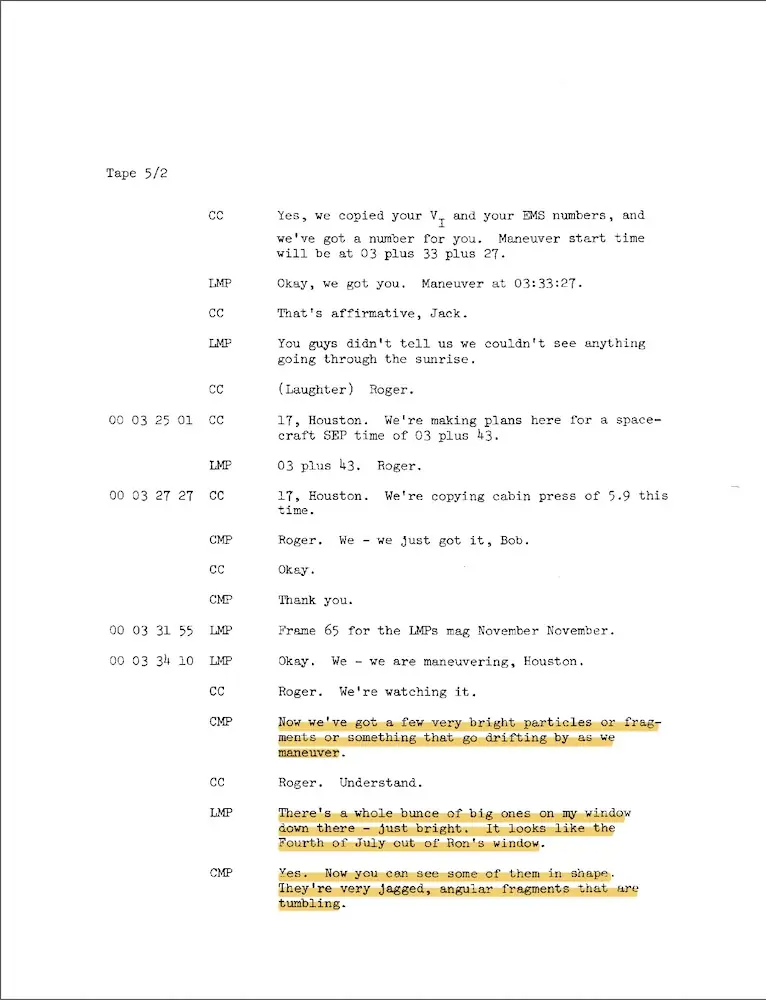
Apollo 17 crew observed numerous bright, jagged, tumbling fragments during S-IVB separation maneuver, plus a distinct distant bright object rotating with alternating bright and dull flashes, estimated 10-12 Earth diameters away, separate from nearby particles.
Notable Characteristics
- Color: bright (flashing)
- Luminosity: very bright with rhythmic flashes
- Altitude: 10-12 Earth diameters from spacecraft
Reported Motion
- rotating, flashing rhythmically; static field post-maneuver
Evidence Notes
- Direct astronaut voice reports
- Photographic attempts (Frames 65, 70, 50)
- Monocular observation
Apollo 17 crew meticulously described nearby tumbling fragments and a separate distant flashing object during S-IVB separation; ground control suggested S-IVB as source, but crew emphasized distinction from particles.
Unclear
EYE, MONOCULAR
90%
Prosaic Leads
- S-IVB upper stage rotating post-separation, with engine bell causing dual flashes
- Space debris or paint/ice fragments from launch vehicle
- Reflections from sunlight on metallic surfaces
Anomalous Indicators
- Crew insistence object was 'physical in the distance,' not a nearby particle
- Rhythmic dual-flash pattern distinct from tumbling fragments
- Prior sightings noted by crew over 24 hours
Evidence Gaps
- No independent sensor data (e.g., radar, telemetry) confirming object
- Crew photos (Frames 65, 70, 50) not analyzed here
- Exact spacecraft attitude and gimbal angles for ground tracking incomplete
Evidence Quotes // source statements
Open archive"It's a bright object, and it's obviously rotating because it's flashing. It's way out in the distance... It's something physical in the distance."
Gene Cernan (CDR), Apollo 17 Commander / NASA
Describing object distinct from nearby particles.
"One unique thing about it... it's got two flashes. As it comes around... you get a very bright flash; and then you get a dull flash."
Gene Cernan (CDR), Apollo 17 Commander / NASA
Detailing flash pattern during ground control discussion.
"No question in my mind but that they're there."
Gene Cernan (CDR), Apollo 17 Commander / NASA
Affirming visibility of flashes.
"Crew observed jagged, angular fragments tumbling slowly, possibly S-IVB debris, ice, or paint."
Ronald Evans (CMP), Apollo 17 Command Module Pilot / NASA
During separation maneuver.
Pattern Mesh // linked sightings
Unresolved UAP Report, United Arab Emirates, October 2023
The United States Central Command submitted a report of an unidentified anomalous phenomenon to the All-domain Anomaly Resolution Office (AARO) consisting of four minutes and 57 seconds of video footage from an infrared (IR) sensor aboard a U.S. military platform in 2023. An accompanying mission report, DoW-UAP-D23, mentions a UAP was observed during the mission. Video Description: 00:00-01:55: No content. 01:56: An area of contrast becomes distinguishable against the background in the center of the right side of the display. 02:04: The IR sensor pans to center on the area of contrast. 02:14: The sensor field-of-view narrows to zoom in on the area of contrast. 02:15-03:26: The area of contrast remains generally in the center of the sensor field-of-view. 03:27-04:57: The sensor motion causes the area of contrast to move erratically across the display. Due to this motion, the sensor system repeatedly loses and reacquires the area of contrast within the center area of the display. This video description is provided for informational purposes only. Readers should not interpret any part of this description as reflecting an analytical judgment, investigative conclusion, or factual determination regarding the described event’s validity, nature, or significance.
Same source archive
Shared tags: pursue-release-1, release-1
Unresolved UAP Report, United Arab Emirates, October 2023
The United States Central Command submitted a report of an unidentified anomalous phenomenon to the All-domain Anomaly Resolution Office (AARO) consisting of 43 seconds of video footage from an infrared sensor aboard a U.S. military platform in 2023. An accompanying mission report, DoW-UAP-D23, mentions a UAP was observed during the mission. Video Description: 00:00-00:17: An area of contrast remains generally within the top left quarter of the display. 00:17-00:18: The sensor pans from right to left, causing the area of contrast to pass through the center of the display. The sensor then pans from left to right, causing the area of contrast to return to its approximate initial position within the sensor field-of-view. 00:29: The sensor stops tracking the area of contrast, causing it to leave the sensor field-of-view on the left side of the screen. 00:30-00:43: The sensor resumes its motion relative to the background but does not reacquire the area of contrast. This video description is provided for informational purposes only. Readers should not interpret any part of this description as reflecting an analytical judgment, investigative conclusion, or factual determination regarding the described event’s validity, nature, or significance.
Same source archive
Shared tags: pursue-release-1, release-1
Unresolved UAP Report, Syria, October 2024
The United States Central Command submitted a report of an unidentified anomalous phenomenon (UAP) to the All-domain Anomaly Resolution Office (AARO) consisting of five seconds of video footage from a full-motion video (FMV) camera aboard a U.S. military platform in 2024. An accompanying mission report, DoW-UAP-D32, described the UAP as consisting of a “misshapen and uneven ball of white light,” and reported that a “light/glare halo effect” occurred at the top of the FMV feed. Video Description: 00:01-00:03: Two semi-transparent, irregularly shaped orange areas overlay the background imagery, persisting for less than two seconds each. This video description is provided for informational purposes only. Readers should not interpret any part of this description as reflecting an analytical judgment, investigative conclusion, or factual determination regarding the described event’s validity, nature, or significance.
Same source archive
Shared tags: pursue-release-1, release-1
Unresolved UAP Report, Syria, October 2024
The United States Central Command submitted a report of an unidentified anomalous phenomenon (UAP) to the All-domain Anomaly Resolution Office (AARO) consisting of six seconds of video footage from a full-motion video (FMV) camera aboard a U.S. military platform in 2024. An accompanying mission report, DoW-UAP-D32, described the UAP as consisting of a “misshapen and uneven ball of white light,” and reported that a “light/glare halo effect” occurred at the top of the FMV feed. Video Description: 00:02-00:04: An area of irregular color and brightness, mainly consisting of white and red highlights, appears near the center of the top edge of the sensor display. The area extends to a width of approximately one-third of the horizontal frame, with a vertical area comprising approximately one-sixth of the viewing area. Overall, its shape is best described as a horizontally-oriented half-oval bisected along its major axis. This video description is provided for informational purposes only. Readers should not interpret any part of this description as reflecting an analytical judgment, investigative conclusion, or factual determination regarding the described event’s validity, nature, or significance.
Same source archive
Shared tags: pursue-release-1, release-1
Unresolved UAP Report, Syria, October 2024
The United States Central Command submitted a report of an unidentified anomalous phenomenon (UAP) to the All-domain Anomaly Resolution Office (AARO) consisting of five seconds of video footage from a full-motion video (FMV) camera aboard a U.S. military platform in 2024. An accompanying mission report, DoW-UAP-D32, described the UAP as consisting of a “misshapen and uneven ball of white light,” and reported that a “light/glare halo effect” occurred at the top of the FMV feed. Video Description: 00:00-00:01: An indistinctly shaped multi-colored area moves from right to left across the top edge of the sensor display within the first second of the video. This video description is provided for informational purposes only. Readers should not interpret any part of this description as reflecting an analytical judgment, investigative conclusion, or factual determination regarding the described event’s validity, nature, or significance.
Same source archive
Shared tags: pursue-release-1, release-1
Unresolved UAP Report, Syria, July 2022
The United States Central Command submitted a report of an unidentified anomalous phenomenon (UAP) to the All-domain Anomaly Resolution Office (AARO) consisting of 14 seconds of video footage from an infrared (left) and electro-optical (right) sensor aboard a U.S. military platform in 2022. An accompanying mission report, DoW-UAP-D16, described the UAP as “moving from north to south.” Video Description: At the five second mark, the video depicts an object moving from right to left across the top right quarter of the sensor field-of-view. This video description is provided for informational purposes only. Readers should not interpret any part of this description as reflecting an analytical judgment, investigative conclusion, or factual determination regarding the described event’s validity, nature, or significance.
Same source archive
Shared tags: pursue-release-1, release-1
Chronology Trace // before & after
Apollo 12 NASA UAP Image, 1969
Moon
Apollo 12 Lights Escaping Moon, 1969
Moon
Apollo 12 Moon Anomaly Image, 1969
Moon
Apollo 12 Lunar Anomaly Highlighted, 1969
Moon
Skylab Crew's Unidentified Lights and Satellite, 1973
PURSUE Program
Apollo 17 Crew Debriefing Science Mysteries, 1973
PURSUE Program
Apollo 17 Crew Debriefing: Fireball and Light Flashes
PURSUE Program
Official Files // source material
1 linkedNASA-UAP-D2, Apollo 17 Transcript, 1972
Tape 5/2 CC Yes, we copied your VI and your EMS numbers, and we've got a number for you. Maneuver start time will be at 03 plus 33 plus 27. LMP Okay, we got you. Maneuver at 03:33:27. cc That's affirmative, Jack. LMP You guys didn't tell us we going through the sunrise. couldn't see anything cc (Laughter) Roger. 00 03 25 01 cc 17, Houston. We're making plans here craft SEP time of 03 plus 43. for a space LMP 03 plus 43. Roger. 00 03 27 27 cc 17, Houston. time. We're copying cabin press of 5.9 this CMP Roger. We - we just got it, Bob. cc Okay. CMP Thank you. 00 03 31 55 LMP Frame 65 for the LMPs mag November November. 00 03 34 10 LMP Okay. We - we are maneuvering, Houston. cc Roger. We're watching it. CMP Now we've got a few very bright particles ments or something t
Community Discussion
0 commentsSigned-in researchers discussing Apollo 17's Flashing Distant Object, 1972. Share observations, cross-references, or questions.
Sign in to join the discussion on this signal.
Sign in to comment